
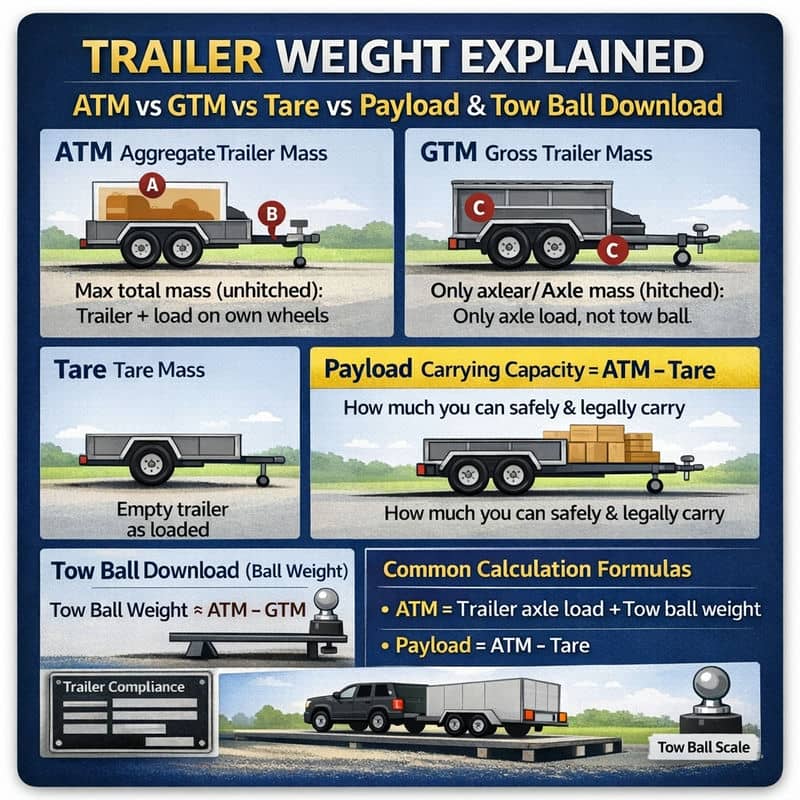
If you’ve ever heard “Don’t exceed your ATM” but weren’t sure what that actually means, you’re not alone. Trailer weight terms get mixed up all the time—and that’s how people overload trailers, exceed tow vehicle limits, or end up with poor stability and sway.
This guide breaks down the 5 numbers that matter most in Australia: ATM, GTM, Tare, Payload, and Tow Ball Download (Tow Ball Weight). You’ll learn what each term means, how they relate, and how to calculate your real carrying capacity in minutes.
The 5 Trailer Weight Terms
1) ATM (Aggregate Trailer Mass)
ATM is the maximum permitted total mass of the trailer when fully loaded.
It includes the mass on the trailer wheels and the downward force on the tow ball/coupling.
Think: Trailer + load, sitting on its own wheels + jockey wheel (uncoupled).
2) GTM (Gross Trailer Mass)
GTM is the maximum permitted mass carried by the trailer wheels/axles when the trailer is hitched.
It does not include the weight transferred onto the tow ball.
Think: Loaded trailer’s axle load (hitched).
3) Tare Mass (Tare Weight)
Tare is the trailer’s mass when it’s empty and “ready for service”.
This includes standard equipment and fitted options.
Important: don’t guess. Use the trailer compliance plate as your baseline.
4) Payload (Carrying Capacity)
Payload is how much you can legally carry in/on the trailer.
Payload = ATM − Tare
5) Tow Ball Download (Tow Ball Weight / Ball Load)
This is the downward force the trailer coupling applies to the tow vehicle’s tow ball when hitched.
A practical relationship (rated condition guide) is:
Tow Ball Download ≈ ATM − GTM
Real ball weight can change depending on how and where you load items, so measuring is best.
The Two Formulas You Should Remember你应该记住的两个公式
When the trailer is hitched and loaded:
- ATM = (Trailer axle load) + (Tow ball download)
- GTM = Trailer axle load
- Therefore: Tow Ball Download = ATM − GTM (rated condition relationship)
And for carrying capacity:
- Payload = ATM − Tare
Quick Calculation (60 Seconds)
- Find ATM, GTM, Tare on the trailer compliance plate
- Calculate payload:
Payload = ATM − Tare
- Check tow vehicle limits (separate from trailer limits):
- Maximum braked towing capacity
- Maximum tow ball download (tow ball mass)
- Vehicle payload / axle loads (ball weight uses up vehicle payload)
Worked Example (With Real Numbers)
Let’s say your trailer compliance plate shows:
- Tare = 450 kg
- ATM = 2000 kg
- GTM = 1850 kg
Step A — Payload
Payload = 2000 − 450 = 1550 kg
So the maximum legal load you can carry is 1550 kg.
Step B — Tow Ball Download (Rated Condition Guide)
Tow Ball Download ≈ 2000 − 1850 = 150 kg
Now check your tow vehicle specs. If your vehicle’s max tow ball download is 120 kg, you have a problem even if the trailer is under ATM.
How to Weigh It Properly (Without Guessing)
Option A — Public Weighbridge (Best Practice)
At a weighbridge:
- Weigh tow vehicle + trailer (hitched)
- Then weigh tow vehicle alone
This helps you understand the trailer load and how weight is being shared.
Option B — Measure Ball Weight Directly
Use a tow ball scale / ball weight gauge.
This is the simplest way to confirm tow ball download without relying on estimates.
Common Mistakes (And How to Avoid Them)
Mistake 1: “My trailer can carry 2000 kg”
Not necessarily. ATM is total mass, not payload.
Example: ATM 2000 kg and tare 450 kg means payload is 1550 kg, not 2000.
Mistake 2: Ignoring tow ball download
Ball weight counts against your tow vehicle payload and can push you over:
- maximum tow ball mass
- axle load limits
- vehicle GVM
Mistake 3: Mixing up GTM and ATM
GTM is usually lower than ATM because some weight transfers onto the tow vehicle via the coupling.
Mistake 4: Adding accessories without re-checking payload
Toolboxes, cages, ramps, spare wheels—all add mass.
More accessories = less remaining payload because payload is capped by ATM − Tare.
Mistake 5: Assuming upgrades automatically increase legal ratings
Upgrading axles, brakes, or springs does not automatically increase ATM/GTM.
Legal ratings come from the manufacturer/engineering and appear on the compliance plate.
A Simple Safe Towing Checklist
Before loading:
- Confirm ATM, GTM, Tare on the trailer plate
- Calculate payload: ATM − Tare
- Confirm tow vehicle max tow ball download and towing capacity
- Balance the load:
- Too rear-heavy → sway risk
- Too front-heavy → excessive ball weight
If you’re not sure which trailer rating suits your job (single axle vs tandem, box vs plant, etc.), share:
- what you’re carrying (materials / machines / tools)
- estimated total load weight
- tow vehicle model
and you can choose a trailer mass rating and setup with more confidence.
FAQ
Q1: Does tow ball weight count in ATM?
Yes. ATM includes the downward force on the tow ball/coupling.
Q2: Is GTM the same as ATM?
No. GTM is the mass on the trailer wheels/axles when hitched. ATM includes GTM plus tow ball download.
Q3: How do I calculate trailer payload?
Payload = ATM − Tare.
Q4: Why can I exceed my tow vehicle limits even if the trailer is under ATM?
Because tow ball download uses up tow vehicle payload and can exceed tow ball mass or axle/GVM limits.
Q5: Can I increase ATM by upgrading axles or brakes?
Not automatically. Legal ratings are plate/manufacturer values and may require engineering/certification if changed.