
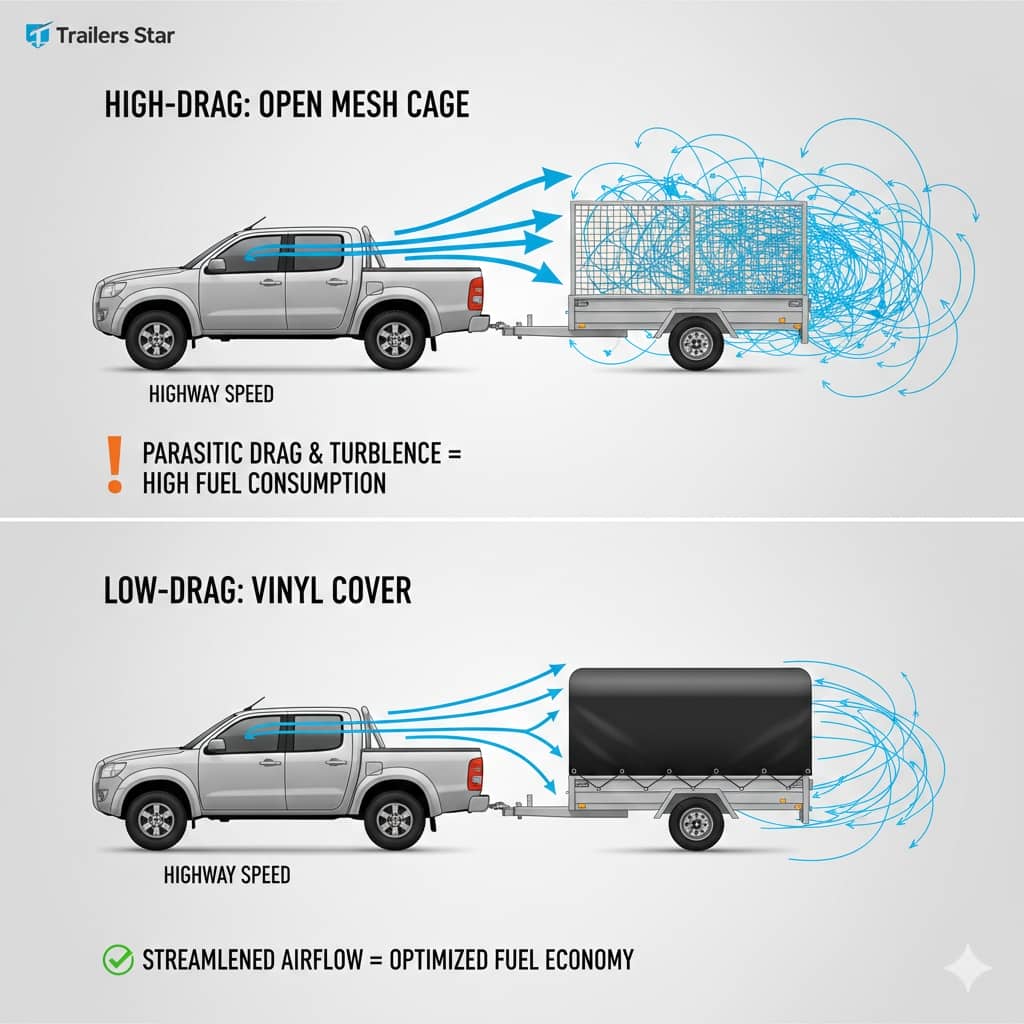
For professional contractors and long-haul drivers in Victoria, fuel is often the single largest operating expense. With diesel prices hovering around $1.82/L and petrol at $1.75/L (Melbourne 2026 averages), the “brick-wall effect” of a poorly configured trailer can cost you thousands of dollars a year in wasted fuel.
At highway speeds, aerodynamic drag becomes the dominant force your vehicle must overcome. While many people focus on weight, the shape of your trailer is what truly dictates your fuel stops.
1. The Cage vs. The Van Trailer: A 15% Efficiency Gap
A common misconception among Victorian drivers is that a mesh cage is aerodynamic because “air passes through the holes.” In reality, the physics tells a different story.
- The Metal Cage (The “Wind Fence”): At 100km/h, a mesh cage acts like a solid barrier. The air doesn’t just pass through; it creates thousands of tiny, high-drag vortices behind every wire and inside the open tub. This “parasitic drag” forces your engine to work significantly harder.
- The Van Trailer (The “Streamlined Pro”): An enclosed Van Trailer provides a smooth, continuous surface that allows air to glide over the vehicle’s wake. By eliminating the turbulence caused by an open tub and cage, you effectively turn your trailer into a streamlined extension of your tow vehicle.
- The Result: Switching from a high-walled cage trailer to a sleek Enclosed Van Trailer can reduce aerodynamic drag by up to 25%, leading to fuel savings of 10% to 15% on long freeway hauls.
2. The “Parachute Effect”: Height vs. Wake
The most efficient towing setup is one where the trailer “hides” in the aerodynamic shadow of your Ute or SUV.
- Height Matching: If your trailer protrudes significantly above the roofline of your tow vehicle, it acts like a parachute. For every 10cm of exposed frontal area above your vehicle’s roof, your fuel consumption climbs.
- Van Trailer Advantage: Our Van Trailers are designed with professional proportions that balance internal volume with a profile that sits within the “clean air” zone behind most modern dual-cab Utes.
3. Crunching the Numbers: The Melbourne to Adelaide Professional Run
Let’s look at a typical 725km trip from Melbourne to Adelaide for a commercial contractor:
| Trailer Setup | Est. Fuel Consumption | Total Fuel Used | Cost (at $1.82/L) |
| Optimized (Van Trailer) | 12L / 100km | 87 Litres | **$158.34** |
| High Drag (Open Cage & Gear) | 16L / 100km | 116 Litres | $211.12 |
| The Difference | +4L / 100km | +29 Litres | $52.78 extra per trip |
If you perform this run once a week, you are spending over $2,700 extra per year simply fighting the wind. A premium Van Trailer essentially pays for itself in fuel savings alone over its lifetime.
Professional Summary: Your Efficiency Checklist
- Enclose the load: An Enclosed Van Trailer is the ultimate tool for both aerodynamics and tool security.
- Level the hitch: A trailer that tilts up or down exposes more surface area to the wind, increasing drag.
- Tire Pressure: Aerodynamics only works if your rolling resistance is low. Ensure your trailer tires are at the manufacturer’s recommended PSI for heavy loads.
Ready to stop paying the “Wind Tax”?
Upgrade your business with a professional, fuel-efficient Van Trailer from Trailers Star. Secure your gear, protect your load from Melbourne’s weather, and start saving at the pump today.