
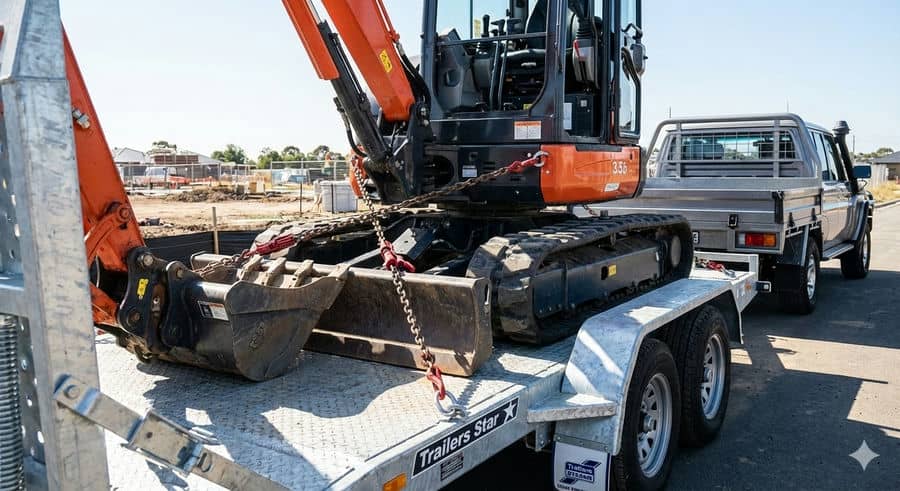
Towing a 6×4 box trailer to the tip is one thing. Towing a 3.5t excavator down the Monash Freeway at 100km/h is an entirely different ball game.
For Victorian contractors and plant hire operators, getting heavy machinery to the site safely isn’t just about protecting your expensive equipment; it’s about protecting everyone else on the road—and your livelihood. A single incident of severe trailer sway (snaking) with heavy plant on board is usually catastrophic.
At Trailers Star, we build our Plant Trailers tough, but safety ultimately comes down to how you load it.
Here is the masterclass on balancing weight and locking it down.
1. The Physics of Survival: Center of Gravity (COG)
The most critical moment of your journey happens before you even leave the yard: deciding where to park the machine on the deck.
You are trying to achieve the perfect “Tow Ball Download” (TBD)—usually around 10% of the total loaded trailer weight pushing down on your vehicle’s tow ball.
The “Goldilocks Zone”
Every machine (excavator or skid steer) has its own center of gravity. You need to position that COG slightly ahead of the trailer axles.
Scenario A: Too Far Forward (The Nose Dive)
If you park the machine right up against the front headboard, you put excessive weight on the tow vehicle’s rear axle.
- The Result: Your tow vehicle’s front wheels lift, causing vague, floaty steering and reduced braking efficiency. Your headlights will also blind oncoming traffic at night.
Scenario B: Too Far Back (The Death Wobble)
This is the most dangerous scenario. If the machine’s weight is centered behind the trailer axles, the trailer tongue lifts up on your towbar.
- The Result: Violent Trailer Sway. At speed, a slight side wind or steering correction can cause the trailer to pendulum uncontrollably, often jackknifing the rig.
The Visual Rule of Thumb:
For most standard excavators, the perfect balance point is usually achieved when the machine’s tracks are centered slightly forward of the trailer’s axle group.
Crucial Tip: Always lower attachments (buckets, blades, augers) flat onto the trailer deck. This lowers the overall center of gravity and improves stability.
2. The Lockdown: Chains vs. Ratchets & The 4-Point Rule
Once the weight is balanced, it must not move. VicRoads and the NHVR (National Heavy Vehicle Regulator) are extremely strict on load restraint. The forces generated during emergency braking or a swerve are immense.
Chains vs. Straps: What to use for “Plant”?
While heavy-duty ratchet straps are excellent for general freight, chains and load binders (dogs) are the gold standard for tracked machinery like excavators.
- Why Chains? Steel tracks on steel trailer decks can be slippery. Chains do not stretch under load like polyester straps can, and they are resistant to cuts from sharp edges on the machine’s undercarriage.
- If using Straps: They must be ultra-heavy-duty, rated for the specific load, and protected with anti-abrasion sleeves where they contact the machine.
The 4-Point Direct Restraint Method
Never rely on just two tie-downs or looping a single chain over the tracks. You must use the 4-Point Direct Restraint method using designated tie-down points on the machine’s chassis (check your machine’s manual).
The Technique: Create an “X” pattern with opposing forces.
- Front Left Corner: Chain goes from the machine’s front-left tie-down point, diagonally forward to the trailer’s front-left anchor point.
- Front Right Corner: Chain goes from the machine’s front-right tie-down point, diagonally forward to the trailer’s front-right anchor point.
- Rear Left Corner: Chain goes from the machine’s rear-left point, diagonally backward to the trailer’s rear-left anchor point.
- Rear Right Corner: Chain goes from the machine’s rear-right point, diagonally backward to the trailer’s rear-right anchor point.
Why this works: The front chains stop the machine sliding backward. The rear chains stop it sliding forward. The diagonal angles prevent it moving sideways.
Summary: Don’t Cut Corners on Heavy Haulage
Loading a plant trailer correctly takes an extra 10 minutes. But skipping these steps risks your machine, your tow vehicle, and your license.
A heavy-duty job requires a heavy-duty trailer. Our Trailers Star Plant Trailer range is designed with reinforced chassis, heavy-duty ramps, and strategically placed, rated tie-down points to make safe loading easier.
Need a rig that can handle the weight? Check out our purpose-built Plant Trailers here, designed for Victorian Tradies who haul serious gear.