
Matching the right tow vehicle to your trailer is about more than “can it pull it?”. The correct setup protects legal compliance, improves towing stability, and reduces stress on your vehicle’s drivetrain and brakes.
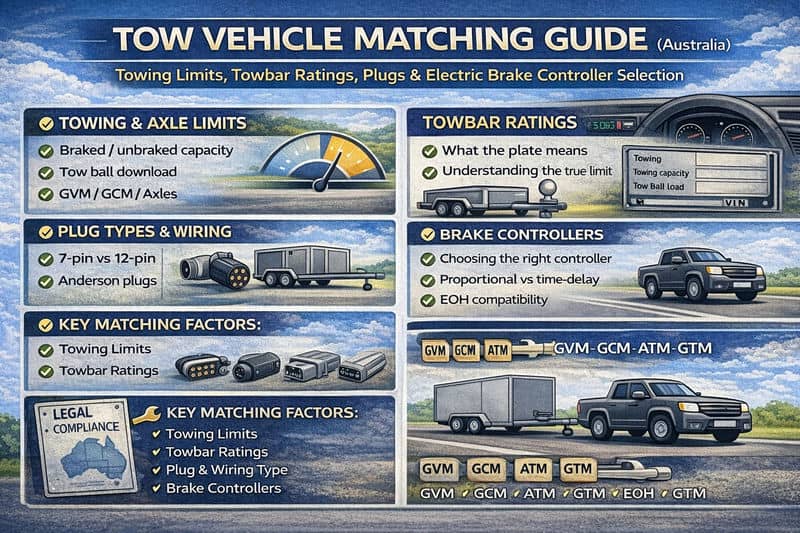
This guide covers:
- Towing limits: towing capacity, tow ball download, GVM/GCM and axle loads
- Towbar ratings: what the plate means and why it can be the limiting factor
- Trailer plugs and wiring: 7-pin vs 12-pin, Anderson plugs and what each is used for
- Electric brake controller selection: proportional vs time-delayed, and EOH compatibility
1) Start with the 6 numbers that decide if you’re within limits
Always work from the manufacturer specs for your tow vehicle and the compliance plate on the trailer/towbar. The safe rule is:
Your real limit is the lowest limit among vehicle, towbar, hitch/coupling, and trailer ratings.
1.1 Braked towing capacity
The maximum trailer mass your vehicle can tow when the trailer has effective brakes. This is often the headline number, but it is not the only limit.
1.2 Unbraked towing capacity
The maximum trailer mass you can tow without trailer brakes. This is usually much lower than braked towing capacity.
1.3 Maximum tow ball download (tow ball mass)
The maximum downward load allowed on the tow ball. Exceeding this is a common cause of vehicle overload, rear sag, poor steering feel, and stability issues.
1.4 GVM (Gross Vehicle Mass)
Your tow vehicle’s maximum allowed mass when loaded: vehicle + passengers + fuel + cargo + accessories + tow ball download.
1.5 GCM (Gross Combination Mass)
The maximum allowed mass of the vehicle and trailer together when hitched and loaded. You can be under “towing capacity” but still exceed GCM depending on how the vehicle is loaded.
1.6 Axle load limits
Many vehicles have front and rear axle limits. Tow ball download adds load to the rear axle and can reduce front axle load (affecting steering and braking).
2) Confirm the trailer’s key ratings (don’t guess)
2.1 ATM and GTM matter
- ATM (Aggregate Trailer Mass): maximum total trailer mass when fully loaded (includes tow ball download component).
- GTM (Gross Trailer Mass): maximum mass on the trailer wheels/axles when hitched.
2.2 Practical rule for matching
- If your tow vehicle’s braked towing capacity is less than your trailer’s maximum loaded mass, you’re over the vehicle limit.
- If your tow vehicle’s tow ball download limit is less than your real ball weight, you’re over limit even if the trailer is under ATM.
Tip: Ball weight is affected by where the load sits. Rear-heavy loading increases sway risk; front-heavy loading can overload the tow vehicle and towbar.
3) Towbar ratings: the hidden limiting factor
Your towbar has its own rating plate. It usually lists:
- Maximum trailer mass (sometimes stated as “towing capacity” for the bar)
- Maximum ball load
3.1 What to do if numbers conflict
If your vehicle can tow 3500 kg but your towbar is rated to 3000 kg, then your practical limit is 3000 kg. Same for ball load.
3.2 Hitch and coupling ratings
The hitch (50mm ball, off-road coupling, pintle, etc.) and the trailer coupling also have ratings. The lowest-rated part sets your limit.
4) Trailer plugs & wiring: choosing the right connector
4.1 7-pin flat or 7-pin round
Common for basic trailer lighting: indicators, tail lights, brake lights, and sometimes reverse/aux depending on wiring standard.
4.2 12-pin (often used for caravans)
Provides extra circuits for accessories such as fridge power, charging circuits, reverse lights, or auxiliary feeds (varies by build).
4.3 Anderson plug (common for higher current)
Used for higher-current loads like battery charging, fridge circuits, or caravan power supply. Often paired with 7/12-pin for lights + brakes.
4.4 Where the electric brake signal runs
Electric trailer brakes require a brake output wire from the controller to the trailer plug, plus a solid earth/ground. Poor grounding is a top cause of weak or inconsistent braking.
5) Electric brake controller selection (including EOH)
If your trailer uses electric drum brakes or electric-over-hydraulic (EOH), you generally need a brake controller.
5.1 Proportional vs time-delayed controllers
- Proportional (inertia-based): matches trailer braking to deceleration. Smoother and usually safer for mixed loads and highway towing.
- Time-delayed: ramps braking over time after the brake pedal is pressed. Lower cost, but less refined.
5.2 EOH compatibility (important)
Not all controllers work correctly with EOH actuators. If you have EOH, choose a controller that explicitly supports EOH mode and can be configured accordingly.
5.3 Features worth paying for
- Manual override lever/button (useful for stabilising minor sway and for testing)
- Clear gain display and easy adjustment
- Self-levelling / flexible mounting (depending on controller model)
- Diagnostics (connection and fault indicators)
5.4 Basic setup (safe starting point)
- Set gain to a moderate value
- Test at low speed in a safe area (around 20–30 km/h)
- Increase gain until braking is supportive without easy wheel lock-up
- Re-test when you change load or loading position
6) Quick matching checklist (copy/paste)
- Vehicle: braked towing capacity, unbraked towing capacity, tow ball download limit, GVM, GCM, axle limits
- Towbar: towbar max trailer mass, towbar max ball load
- Trailer: ATM, GTM, braking type (over-run / electric / EOH), breakaway fitted if required
- Wiring: correct plug type, brake output wire present, clean earth/ground, Anderson plug if high-current charging is needed
- Controller: proportional preferred for most use; confirm EOH compatibility when relevant
FAQ
Do I always need an electric brake controller?
You generally need one if the trailer has electric brakes or EOH. Over-run/surge systems typically do not require an in-cab controller.
Why does tow ball download matter so much?
Because it counts toward tow vehicle payload and can push you over GVM/rear axle limits, even if the trailer itself is under ATM.
Can a plug upgrade fix weak trailer brakes?
Sometimes. But weak brakes are more often caused by poor earth/ground, undersized wiring, corroded pins, or incorrect controller setup. Diagnose before replacing parts.